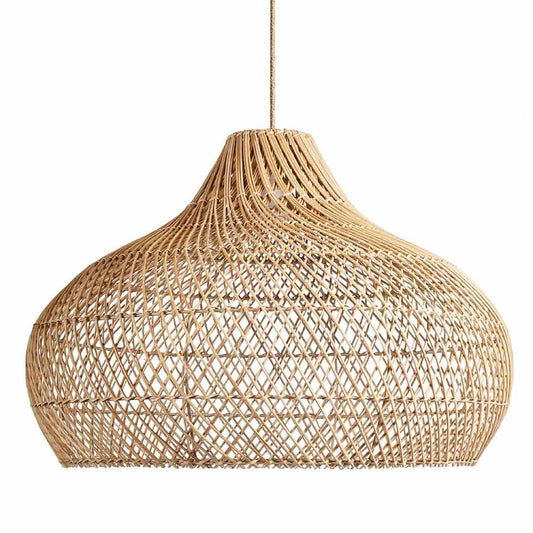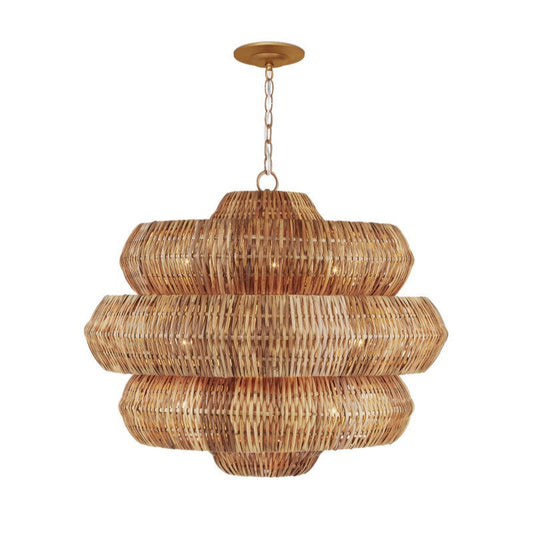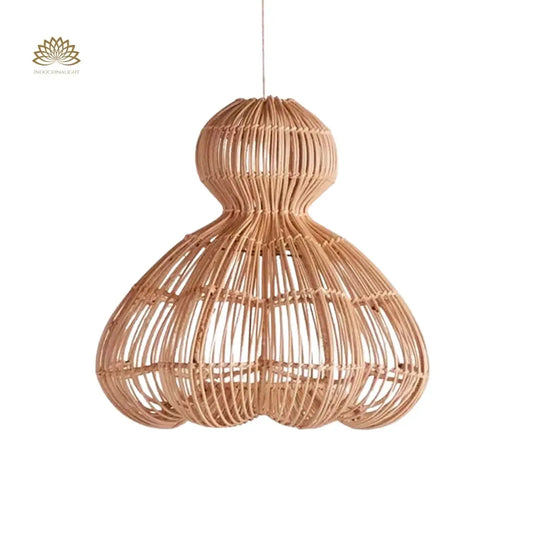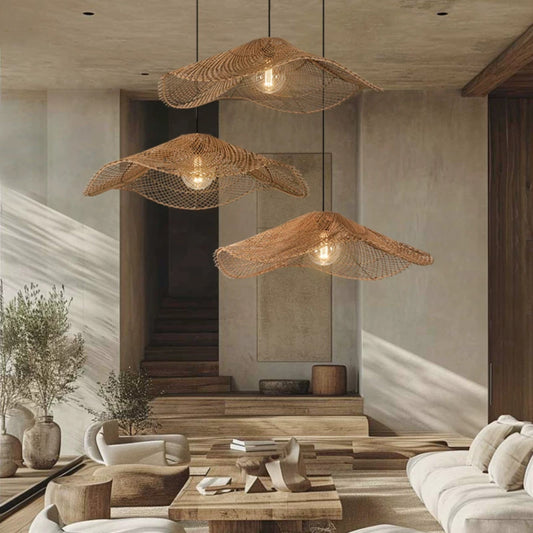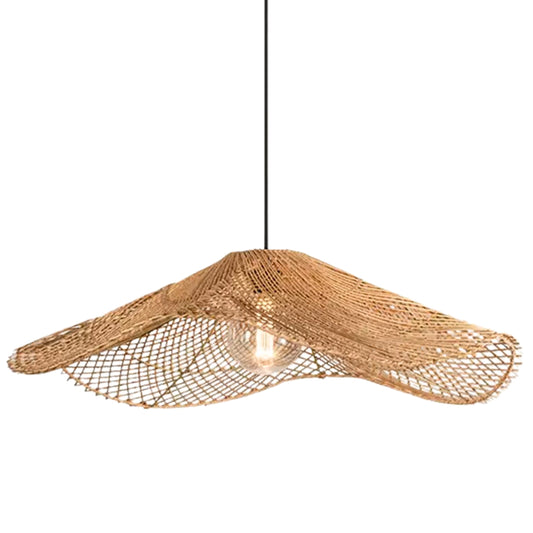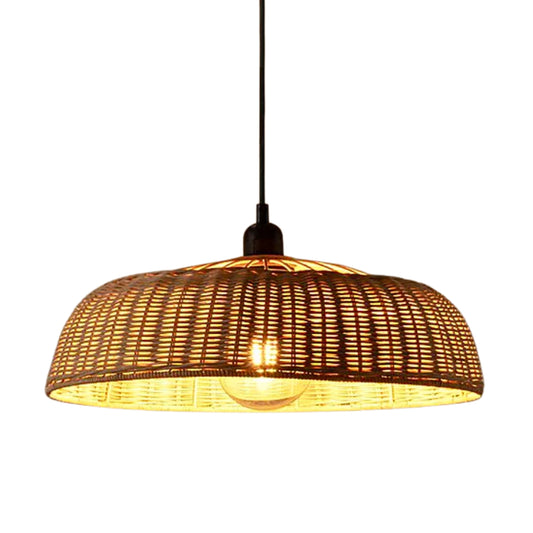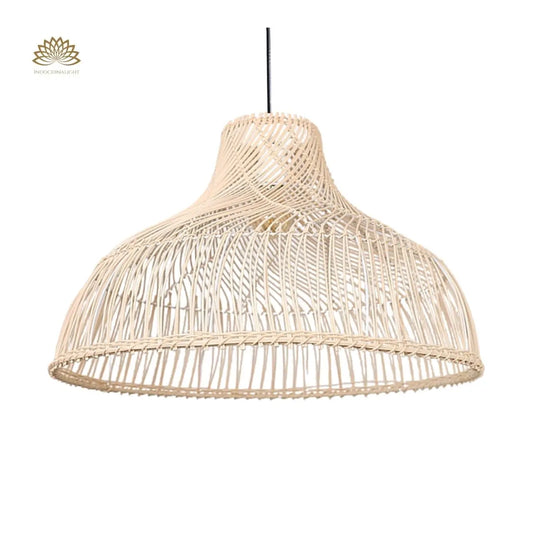
Rattan is the solid stem of a climbing palm, and it differs from the three materials it gets confused with in three distinct ways: cane is the outer skin peeled from that same vine, wicker is a weaving technique rather than a material, and bamboo is an unrelated hollow grass. Roughly 600 species grow across the tropical forests of Southeast Asia and Africa.
That solid core is what separates rattan from every look-alike. Steam softens it enough to bend a pole into a permanent curve, which is why rattan takes shapes that bamboo splits under and timber cracks against. Stems run from 2 millimeters for fine weaving to over 2 inches for furniture frames, and the vine regrows on a 5 to 7 year cycle.
This guide separates rattan from cane, then from wicker, then from bamboo, before moving on to what rattan is actually used for in furniture and pendant lighting and how to tell a high-quality pole from a cheap one. Read it and the next woven piece you pick up stops being a guess: you will name the material correctly and know whether it was built to last before you pay for it.
What is Rattan?
Rattan is the solid stem of a climbing palm in the subfamily Calamoideae. It is not a tree, not a grass, and not a weaving style. Around 600 species grow across the tropical forests of Southeast Asia and Africa, and commercial furniture and lighting draw on roughly 40 of them. The genus harvested most often is Calamus, the largest of the rattan genera.
The stems vary enormously in size. Fine weaving uses strands as thin as 2 millimeters, while furniture frames need poles thicker than 2 inches (5 cm). These vines climb by hooking onto host trees, and Palasan rattan can reach 500 feet (152 m) with stems 1 to 2 inches (2.5 to 5 cm) wide. Once harvested, the stems get cut into 13-foot (4 m) lengths and stripped of their dry outer sheathing.
That solid fibrous core is what makes rattan usable. Steam softens the fibers enough to bend a pole into a curve, and the curve holds permanently once the pole cools. This is the mechanical reason rattan works for chair frames and lampshade rings where straight-grained timber would crack. It also regrows on a harvest cycle of 5 to 7 years against decades for tropical hardwood, and because the vine needs standing trees to climb, growing it gives forest communities a reason to leave the forest standing.

What Are the Key Characteristics of Rattan?
The key characteristics of rattan are four properties that rarely appear together: a high strength-to-weight ratio, the ability to steam-bend, a light golden color that takes stain or whitewash, and a fast renewal cycle. Rattan handles humidity better than solid timber and warps less. It is not waterproof, though, and will grow mold if you let it soak.
- Strength-to-weight: the solid fiber core holds its shape well without a metal frame inside it.
- Flexibility: it steam-bends without snapping, which is how dome, bell, and basket shades get their curves without visible joints.
- Weight: a rattan shade weighs a fraction of a hardwood or metal one, so it hangs safely on a standard junction box with no reinforcement.
- Color: the natural golden tone takes bleaching, whitewash, or black stain, so one shade works across coastal, boho, Japandi, and minimalist palettes.
- Water resistance: it resists humidity but absorbs standing water, so keep your fixture out of unventilated bathrooms and open patios.
- Heat and UV: long hours of direct sun turn the fibers brittle, so hang it away from unshaded windows. LED bulbs run cool enough to be safe.
Natural fiber can host insects and mold in damp conditions, and no finish removes that risk entirely. At IndochinaLight, we treat every fixture with anti-insect lacquer and termite-resistant oil, which is the practical answer to the two failure modes buyers ask about most.

Rattan vs. Cane: The Same Plant, Two Different Materials
Cane and rattan come from the same plant. Cane is the outer bark peeled off the rattan vine; rattan is the solid inner core left behind after peeling. Because cane is the skin, it is less porous than the core, so it handles humidity better and needs less treatment.
Furniture makers follow a simple rule here: the rattan core carries load, the cane skin covers the surface. So the core goes into chair frames, table bases, bed frames, and basket-shade rings, while cane goes into chair backs and seats, cabinet door inserts, headboard panels, and the flat webbing wrapped around pendant light drums, always applied over an existing frame. That porosity difference has a damp-room consequence worth knowing: cane is the better pick for humid spaces, which is why it turns up on bathroom vanities where a rattan core would swell.
| Part of the plant | Typical furniture use | Why that use |
|---|---|---|
| Rattan core (inner solid stem) | Chair and table frames, bed frames, basket pendant shades, curved structural rings | Steam-bends without snapping and carries structural load |
| Cane (outer bark, flat strips) | Chair backs and seats, cabinet door panels, headboards, pendant drum webbing | Thin and flexible; weaves into breathable open panels over an existing frame |
| Rattan reed (inner core split into strands) | Woven surfaces on baskets, trays, and shade bodies | Absorbs stain and paint evenly because the glossy skin has been removed |
Rattan vs. Wicker: A Material and a Weaving Technique
Rattan is a material. Wicker is a weaving technique. The two are not comparable categories at all, because a wicker basket can be woven from rattan, willow, reed, seagrass, water hyacinth, bamboo, or synthetic resin. Every major source agrees that wicker names a process rather than a plant, yet product listings keep using the word as though it were a material.
| What it is | How to spot it on a product listing | What it tells the buyer |
|---|---|---|
| Rattan | The listing names a fiber: "natural rattan", "Manau rattan" | You know the material, so you can judge durability and price |
| Wicker | The listing names only a weave or a look: "wicker shade", "wicker basket" | You know nothing about the fiber yet, so ask what it is woven from |
A "wicker pendant light" tells you how the shade was made. A "rattan pendant light" tells you what it was made from, and only the second one lets you predict how the piece will age. That gap shows up in price: rattan usually costs more than generic wicker, because wicker may be woven from cheaper fibers. Before you compare two "wicker" listings on price alone, ask each seller what the fiber actually is.
Rattan vs. Bamboo: Solid Core Against Hollow Stem
Rattan is a solid-cored climbing palm. Bamboo is a hollow grass with horizontal growth ridges, called nodes, spaced along the stem. They belong to entirely different plant families. That hollow-versus-solid split is not botanical trivia, either. It decides what shapes each material can take.
| What it is | How to spot it | Which parts it makes |
|---|---|---|
| Rattan | Solid core, smooth surface with faint leaf-node scars, no hollow center when cut | Bent backs and arms, curved frames, woven surfaces, shade rings |
| Bamboo | Hollow tube with visible ring-shaped nodes at regular intervals along the stem | Straight legs, rails, upright poles, rectilinear frames |
Rattan steam-bends into continuous curves. Bamboo stays straight and must be joined at angular points, which is why a bamboo fixture reads as geometric in your room while a rattan one reads as sculptural.
That split decides which material takes which part of a piece. Rattan gets everything that curves or wraps: bent chair backs and arms, rounded frames, woven seat surfaces, and the rings of a dome or basket lampshade. Bamboo gets everything that stays straight and carries compression, since its hollow tube is stiff along its length but splits when forced into a tight curve. The two share a single piece more often than buyers realize, with straight bamboo poles framing panels filled by rattan strands or cane. On a mixed piece, look at the curves. The curved members are almost always rattan.
What Is Rattan Used For?
Rattan is used for two structural jobs: thick poles form frames, and split strands or peeled cane form woven surfaces. That split explains every rattan product a buyer will pick up, from a dining chair to a pendant shade. Furniture remains the largest commercial use worldwide, and lighting is where the material's optical behavior starts to matter.
Rattan Furniture
Bent poles form the ergonomic frame of a rattan chair, and woven panels form the seat and backrest, which stay breathable in a warm room in a way upholstery cannot. A rattan table pairs a solid cane frame with a woven top, so it carries daily weight without the mass of a timber slab. A rattan basket or tray uses wicker techniques over rattan strands, in shapes from a shallow serving tray to the deep bin in your hallway.

Rattan Pendant Lights
An open weave diffuses light and throws patterned shadows across the wall, and the gap density between strands controls how much light escapes sideways versus falling straight down. LED bulbs on an E26 or E27 base run far cooler than incandescent or halogen, which is why they suit a natural-fiber shade that vents its heat.
IndochinaLight imports Manau rattan from Indonesia, which holds roughly 80% of the world's rattan resources. Manau is the thickest and strongest of the commercial species, so it takes the load-bearing rings of a large shade. Artisans in Phú Vinh village, Vietnam then hand-weave the poles. A tight, consistent weave keeps a wide shade from sagging and produces clean, sharp shadow lines instead of blurred ones.
Shadow quality comes down to weave consistency, so browse our rattan pendant lights to compare tight and open weaves against the wall space you plan to light.

How to Tell High-Quality Rattan from Low-Quality Rattan
Quality rattan gets graded on the pole, before any weaving begins, and three things decide the grade: node spacing, skin condition, and diameter consistency. Grade A rattan needs no paint to hide defects. Density sets the strength underneath all three, and node spacing is the part you can see.
- Skin finish: Grade A rattan has a smooth, naturally glossy skin. Heavy opaque paint on a piece sold as "natural rattan" usually hides cracking or discoloration underneath.
- Node spacing: count the ring-like scars along any visible pole. Widely spaced nodes indicate slower, denser growth, and denser poles are stronger.
- Weave tightness: a tightly woven piece with no gaps at the joints holds its shape. A loose weave stretches and sags over time.
- Joint integrity: check where the strands terminate. Strong pieces tuck and bind the ends; cheap ones glue or staple them.
- Harvest season: autumn-harvested rattan has the lowest moisture and highest density, and we buy that stock at IndochinaLight.
From my experience in the Phú Vinh workshops, the fastest test needs no tools: press a thumbnail into the skin just beside a node. Grade A skin resists and leaves no dent; a softer, lower-grade pole takes the mark and keeps it. Traditional processing without chemical bleaching also leaves the fiber's natural oils in place, which is why untreated Grade A rattan darkens evenly over the years instead of blotching.

How Do You Care for Rattan?
Rattan is a dried natural vine, so care comes down to one variable: moisture control. Keep it dry and out of direct sun, and it will last decades.
- Vacuum weekly with a brush attachment to pull dust out of the weave gaps, where moisture collects and mildew starts.
- Tighten a loose weave by wiping it with warm water mixed with one tablespoon of salt. As they dry, the fibers shrink and pull the weave taut again.
- Prevent brittleness in air-conditioned or heated rooms with boiled linseed oil once a year. Skip cooking oils such as olive oil, which turn rancid.
- Treat mold with a soft toothbrush and a 50/50 mix of water and white vinegar, then dry the spot immediately with a hair dryer or in indirect sun.
Anything beyond these four steps, including deep cleaning and structural repair, is covered in our full rattan cleaning guide.

Frequently Asked Questions About Rattan
Four questions come up again and again once buyers can already identify rattan on sight. They cluster around what a material has to survive in a real home: water, whether rattan counts as wood, how it stacks up against cane, and whether it invites pests.
Is rattan waterproof?
Rattan is not waterproof. It resists humidity but absorbs standing water, which causes swelling, warping, and mold. Light rain does little harm; soaking does real damage. Synthetic PE rattan is the weatherproof alternative.
Is rattan a wood?
Rattan is not a wood. It is a palm stem, not timber, with no growth rings and no hardwood bark layer, so it bends under steam where wood would split. The trade still sells it as "rattan wood", and that is where the confusion starts.
Which is better, cane or rattan?
Neither cane nor rattan is better; they serve different purposes. Rattan core carries the structural load, while cane skin covers surfaces and holds up better in damp conditions. A well-built piece usually contains both.
Does rattan attract roaches?
Rattan does not attract roaches. The fiber draws nothing; pests come for dirt, food residue, and moisture in the weave, so a clean, dry weave stays pest-free. The anti-insect lacquer on our fixtures adds a second layer of protection.
Conclusion
Four terms, four different things. Rattan is the solid core of a climbing palm, cane is the outer skin peeled from that same vine, wicker is the weaving technique that turns either one into a surface, and bamboo is an unrelated hollow grass. Once those are separate, judging a piece gets straightforward: smooth skin, wide node spacing, a tight weave, and no paint covering defects.
IndochinaLight, a leading home decor brand, offers eco-friendly, handcrafted bamboo, wicker, and rattan pendant lights. Since 2019, we've shared Vietnamese craftsmanship globally, blending heritage with modern style. Our rattan pendant lights use Grade A material shaped with traditional weaving techniques, so the structure holds up without sagging and the shade casts clean, sharp shadows on your walls.